Showing posts with label fiction. Show all posts

Friday, January 4, 2013

The Tiger Rising, by Kate DiCamillo

Title:  The Tiger Rising
Author:  Kate DiCamillo
Publisher:  Candlewick Press
Year:  2002
Pages:  128
Genre:  Realistic Fiction
Themes:  Dealing with Loss, Divorce, Friendship, Freedom
Age Range:  3rd through 5th Grade

Summary:
Rob Horton is a twelve-year old boy living with his father in a run-down motel in Florida.  After his mother died, he and his father both withdrew into their own grief, which mostly consisted of pretending they didn't have any.  One day, while waiting for the school bus, Rob discovers something surprising in the woods behind the motel-an actual, real tiger in a cage, pacing back and forth.  And that's not the only thing surprising that happens that day-he also makes a friend.  Sistine Bailey is the new girl at school-even newer than Rob.  Her mother has moved them back to her hometown after she discovers Sistine's dad is having an affair, and unlike Rob, Sistine has no problem sharing her feelings-loudly and often.  She thinks they should let the tiger free, but Rob isn't sure.  Letting animals-or feelings-out of their cage can be dangerous!

Review:
As one might expect from Kate DiCamillo, this book is beautifully written, with eccentric characters and lots of emotion.  The setting (the south) and some of the characters (the slightly mystical, wise old black woman; the quiet, troubled man) are familiar to anyone who has read Because of Winn-Dixie.  For a short book, The Tiger Rising packs a pretty big emotional punch, dealing with issues of divorce, loss, and finding your way through grief.  Spoiler alert-the tiger does not meet a happy end.  But I think that the choices that Rob and Sistine and Rob's father make could be a good jumping off point for discussion.

Teacher Resources:
Scholastic Discussion Guide
Professional Development Institute Literature Guide
Bookrags Novel Study Guide

Tuesday, October 16, 2012

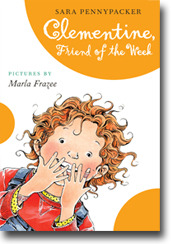
Clementine, Friend of the Week, by Sara Pennypacker

Title:  Clementine, Friend of the Week
Author:  Sara Pennypacker
Publisher:  Hyperion
Year:  2010
Pages:  176
Genre:  Realistic Fiction
Themes:  Friendship
Age Range:  2nd-4th Grade

Summary: (from Goodreads)
Clementine has been picked for Friend of the Week, which means she gets to be line leader, collect the milk money, and feed the fish. Even better, she'll get a Friend of the Week booklet in which all the other third grade kids will write why they like her. Clementine's best friend Margaret has all sorts of crazy ideas for how Clementine can prove to the class she is a friend. Clementine "has" to get a great booklet, so she does what Margaret says. What begins as one of the best weeks ever may turn out to be the worst. Who knew that being a friend could be so hard?
Review:   
Clementine, Friend of the Week is a throw back to some of the books I remember from my own childhood.  Both in writing style and in story it brings to mind Ramona and Harriet and any of Judy Blume's characters.  Clementine is a character that is easily relateable for other little girls, and her struggles, which seem so small from a grown-up perspective, are the types of problems that little girls have when it comes to making and keeping friends.

While most of the story is a sweet and rather funny look at how Clementine plans to bribe and cajole her classmates into giving her good comments in her Friend of the Week booklet, it gains some emotional momentum when her kitten, Moisturizer, gets lost.  He is fine in the end, and his disappearance provides the impetus for making up with her best friend Margaret, but while it was happening I felt her pain and fear.  Pennypacker did a great job making the crisis feel exactly like what it was; a heart-wrenching experience for a loving little girl who is miserable with worry.  This would make a good discussion point, either for discussing character feelings, or for discussing how a character changes at different points in a story.

Monday, October 15, 2012

Calvin Coconut, Trouble Magnet by Graham Salisbury

Title:  Calvin Coconut, Trouble Magnet
Author:  Graham Salisbury
Publisher:  Wendy Lamb Books
Year:  2009
Pages:  160
Genre:  Realistic Fiction
Themes:  Friendship, Family, Bullies
Age Range:  2nd-5th Grade

Summary:
Calvin Coconut lives in Hawaii with his mother and sister.  His father, the famous Little Johnny Coconut, hit it big with his song "A Little Bit of La-la-la Love", and took for for Vegas.  Since then Calvin is supposed to be the man of the house, but trouble seems to follow him wherever he goes.  On his first day of fourth grade, he angers the sixth grade bully, Tito, and even his best friends Julio and Willy think he is going to get pounded.  His cousin, Stella, is coming from the mainland to stay with them, which means he has to move into the storage room in the garage, which comes fully equipped with spiders and other creepy crawlies.  And his new teacher, Mr. Purdy, calls his class "boot camp"  for a reason. Can Calvin manage to avoid all of the trouble that keeps coming his way?

Review:
The one thing I can say that Calvin Coconut, Trouble Magnet has going for it is the unusual setting, and the opportunity to learn some new vocabulary as a result of the island location.  Calvin and his friends introduce us to the culinary delights of "shave ice" and "cuttlefish" and "kim chee", and "dried shrimp".  We also learn the Hawaiian word for mainlanders, "haole".  Calvin is a likeable enough character, and the author did a good job of translating the cadences of Hawaiian English into print.  But unfortunately there is not much substance to go along with the novelty of a Hawaiian setting.  As I read I kept waiting for the point of the story to present itself clearly, and I'm still waiting.  Calvin has problems that kids can relate to, but without any clear resolution.  Calvin solves his bully problem by offering up his cousin Stella as a consolation prize to get Tito off his back-not exactly an honorable solution.  The fact that Stella herself is something of a problem for him is not addressed very well in the course of the book.  Calvin forgets to walk his little sister home from school, but there are no consequences as a result, not even from his sister, who could have easily blackmailed him into some kind of amusing situation.  Overall, I'd say that this book might be an ok addition to a classroom library, but there is just not enough there there to make it worth using in a teaching setting.

Thursday, July 5, 2012

11 Birthdays, by Wendy Mass

Title:  11 Birthdays
Author:  Wendy Mass
Publisher:  Scholastic
Year:  2009
Pages:  267
Genre:  Fantasy, Magical Realism
Themes:  Friendship, Family, Forgiveness
Age Range:  3th-6th Grade


Summary:  (from Goodreads)
It's Amanda's 11th birthday and she is super excited -- after all, 11 is so different from 10. But from the start, everything goes wrong. The worst part of it all is that she and her best friend, Leo, with whom she's shared every birthday, are on the outs and this will be the first birthday they haven't shared together. When Amanda turns in for the night, glad to have her birthday behind her, she wakes up happy for a new day. Or is it? Her birthday seems to be repeating iself. What is going on?! And how can she fix it? Only time, friendship, and a little luck will tell. 


Review:
11 Birthdays is Groundhog Day for the upper elementary set.  Amanda is doomed to repeat her birthday until she figures out what good deed she must make or important action she must take to move on in her life.  This is my first time reading a book by Wendy Mass, and I was impressed with how real Amanda and Leo seemed.  Mass seems to really understand (remember?) what it is like to be 10 going on 11, when you're getting closer to being a teenager and you start worrying about what's cool, who's popular, and who likes who-you know, likes likes...


One of the things that I really like about this book is that it portrays a friendship between a boy and a girl that is deep and abiding, without any hint of romantic attachment.  Amanda doesn't suddenly realize how cute Leo is.  Leo doesn't start blushing fiercely whenever Amanda is around and mumbling.  The friendship feels balanced, with each half having equal power in the relationship.  As a fifth grade teacher, I've noticed how much earlier children are falling into the whole boy/girl (or boy/boy or girl/girl) thing, and I appreciate that Mass shows her readers that it is possible and rewarding to have friends of the opposite gender without romantic overtones.


Mass gives readers plenty to think about with this story.  What is the true nature of forgiveness?  How do you make amends for things that you have done?  How do you balance things you do for other people with things that you do for yourself?  Amanda and Leo struggle with all of these questions through the course of the novel, and I think that this title would be a good one to add to any reading program.


Teacher Resources:
Scholastic Book Talk
Kid's Wings Unit
Kids Book Club Activities

Wednesday, June 20, 2012

Peeled, by Joan Bauer

Title:  Peeled
Author:  Joan Bauer
Publisher:  Putnam Juvenile
Year:  2008
Pages:  256
Genre:  Realistic Fiction
Themes:  Truth, Fear, Manipulation of the Press, Community, Loss
Age Range:  5th through 10th Grade


Summary:  from Goodreads

Something's rotten in the heart of apple country!
Hildy Biddle dreams of being a journalist. A reporter for her high school newspaper, The Core, she's just waiting for a chance to prove herself. Not content to just cover school issues, Hildy's drawn to the town's big story--the haunted old Ludlow house. On the surface, Banesville, USA, seems like such a happy place, but lately, eerie happenings and ghostly sightings are making Hildy take a deeper look.
Her efforts to find out who is really haunting Banesville isn't making her popular, and she starts wondering if she's cut out to be a journalist after all. But she refuses to give up, because, hopefully, the truth will set a few ghosts free.

Review:
Writers like to write about writing-that is clear.  Bauer chose to write about journalism in this book, and she did an excellent job of showing what good journalism can be, even when done by high school students.  But what made this book more charming was the fact that it was essentially a cozy mystery for the tween set.  If you aren't familiar with cozy mysteries, they are mystery novels written around a specific industry or community.  There are cozy mysteries about farmers' markets, wine sellers, tea sellers, book sellers...they always remind me of  that old show Murder, She Wrote.  The setting for Peeled is apple growing country in upstate New York.  Much of the novel revolves around apple growing, apple orchards, selling apple products, etc...The mystery itself is pretty innocuous.  There is a death, but it was not a violent one.  What really drives the novel is the conflict between real journalism and sensational, tabloid style journalism.  While the book is an easy read, there is enough substance there that you could have a discussion about how people can use the media to manipulate public opinion.  Whether you choose to use it as a teaching tool or not, this is a good book to have in your classroom library.

Friday, June 15, 2012

The Miraculous Journey of Edward Tulane, by Kate DiCamillo

Title:  The Miraculous Journey of Edward Tulane
Author:  Kate DiCamillo
Publisher:  Candlewick Press
Year:  2006
Pages:  200
Genre:  Fantasy
Themes:  Love, Friendship
Age Ranges:  3rd-5th Grade


Summary:  from Goodreads
"Someone will come for you, but first you must open your heart. . . ."

Once, in a house on Egypt Street, there lived a china rabbit named Edward Tulane. The rabbit was very pleased with himself, and for good reason: he was owned by a girl named Abilene, who treated him with the utmost care and adored him completely. 

And then, one day, he was lost. 

Kate DiCamillo takes us on an extraordinary journey, from the depths of the ocean to the net of a fisherman, from the top of a garbage heap to the fireside of a hoboes' camp, from the bedside of an ailing child to the bustling streets of Memphis. And along the way, we are shown a true miracle — that even a heart of the most breakable kind can learn to love, to lose, and to love again


Review:
The Miraculous Journey of Edward Tulane is a little jewel of a book.  The setting, the language, and the art are all a throwback to an earlier time, a time of steamships and trains, a time when men rode the rails and children were hungry, a time when toys were made of china and fur and silk and metal, not out of plastic.  The book is completely charming, and quirky in the way that a lot of DiCamillo's work is.  The mood of the book reminds me quite a bit of The Magician's Elephant-there is a sense that something magical and amazing is working just under the surface of everything, from the mundane to the miraculous.  The message of the story, that you can learn to love despite having lost, is a rather mature lesson to learn, but one that is presented in such a way that students can easily understand.  And while we don't like to acknowledge it, many of our students have already dealt or are dealing with loss or a lack of love in their lives, and the book's hopeful message is one that all of us need reminding of when we lose someone we love.


Teacher Resources:


eNotes Lesson Plans
Candlewick Press Teacher's Guide


Monday, June 4, 2012

Deep and Dark and Dangerous, by Mary Downing Hahn

Title:  Deep and Dark and Dangerous
Author:  Mary Downing Hahn
Publisher:  Houghton Mifflin Harcourt
Year:  2007
Pages:  192
Genre:  Supernatural Fantasy
Themes:  Secrets, Family, Ghost Story
Age Range:  4th through 6th Grade

Summary: (from Goodreads)
Just before summer begins, 13-year-old Ali finds an odd photograph in the attic. She knows the two children in it are her mother, Claire, and her aunt Dulcie. But who’s the third person, the one who’s been torn out of the picture?

Ali figures she’ll find out while she’s vacationing in Maine with Dulcie and her four-year-old daughter, Emma, in the house where Ali’s mother’s family used to spend summers. All hopes for relaxation are quashed shortly after their arrival, though, when the girls meet Sissy, a kid who’s mean and spiteful and a bad influence on Emma.

Strangest of all, Sissy keeps talking about a girl named Teresa who drowned under mysterious circumstances back when Claire and Dulcie were kids, and whose body was never found. At first Ali thinks Sissy’s just trying to scare her with a ghost story, but soon she discovers the real reason why Sissy is so angry. . . . 


Review:
Anyone who reads my adult book blog or visits my Goodreads profile will know that I love a good supernatural horror story.  The fact that I have read pretty much everything that Stephen King has ever written is a pretty big clue.  But my love of scary ghost stories started long before I was old enough to read Uncle Stevie...some of my favorite books as a middle grade child were The Figure in the Shadows and The House With the Clock in its Walls by John Bellairs.  Big spooky houses, mysterious noises, creepy characters-I loved being scared.  I can only imagine that Mary Downing Hahn felt similarly, since she has made quite a career of writing scary stories for young readers.


Deep and Dark and Dangerous was the perfect book for me to start my summer reading with.  The cottage that Ali and her aunt and cousin go to for the summer sounds like the perfect getaway-a cozy cottage with a light, airy studio; the cool lake surrounded by beautiful northern forests.  But Hahn quickly turns that idyllic setting into something creepy and menacing.  When Sissy shows up and starts harassing Ali and Emma it is clear that everything is not as it seems.  Soon every shadow, every noise, every bump in the night makes Ali and her family more and more unsettled.  


Despite the spooky atmosphere, the story stays just this side of being too creepy for the intended audience.  In fact, once the ghost is revealed, the story actually becomes more about doing what is right than about scaring the pants off of the reader.  In the end, the story is more about how mean children can be to each other, and how important it is to take responsibility for your mistakes.  This book would be a great addition to any classroom library.  I could even see it as part of a ghost stories theme unit.  But make sure that you read it with the lights on!

Saturday, June 2, 2012

Divergent, by Veronica Roth

Title:  Divergent
Author:  Veronica Roth
Publisher:  Harper Collins
Year:  2011
Pages:  487
Genre:  Dystopian
Themes:  Identity, First Love, Coming of Age
Age Range:  7th Grade and Up

Summary:  (from Goodreads)
In Beatrice Prior's dystopian Chicago, society is divided into five factions, each dedicated to the cultivation of a particular virtue—Candor (the honest), Abnegation (the selfless), Dauntless (the brave), Amity (the peaceful), and Erudite (the intelligent). On an appointed day of every year, all sixteen-year-olds must select the faction to which they will devote the rest of their lives. For Beatrice, the decision is between staying with her family and being who she really is—she can't have both. So she makes a choice that surprises everyone, including herself. 

During the highly competitive initiation that follows, Beatrice renames herself Tris and struggles to determine who her friends really are—and where, exactly, a romance with a sometimes fascinating, sometimes infuriating boy fits into the life she's chosen. But Tris also has a secret, one she's kept hidden from everyone because she's been warned it can mean death. And as she discovers a growing conflict that threatens to unravel her seemingly perfect society, she also learns that her secret might help her save those she loves… or it might destroy her.


Review:

This book was all over the place last year, and was voted the readers' favorite book on Goodreads in their Reader's Choice Awards.  It obviously has wide appeal to the same audience of YA readers that loved The Hunger Games, and they proved it by making it a huge bestseller.  I think that part of what took me so long to read it is that I am leery of clones...you know, like all of the vampire/werewolf/normal girl love stories that came out after Twilight hit it big.  But since everyone I know that's read it has raved about it, I made it the first book on my summer reading list.

And the praise they heap on it is well deserved.  It does not feel like nearly 500 pages, even as a young adult book.  The action is well-paced, and interspersed with enough of Tris's internal struggles to make it more than just an action book, but less than navel-gazing.   And what an interesting character Tris is.  While obviously the protagonist and a sympathetic character, I didn't always like her or approve of her choices.  I was turned off by the violence inherent in the Dauntless lifestyle, and how easily it sometimes was for her to use violence.  But I liked the book more for my ambivalence.  It made the story more thought-provoking.

Though really it didn't need much more than the basic premise to be more thought-provoking.  The idea of my city falling to pieces, the lake replaced by a giant dead marsh, with five different factions running the place gave me plenty to think about.  I think that this book would be an excellent choice for a teen book club.  I don't know that there is enough literary substance there to make it a teachable book for a whole class, but as a way to get reluctant teen readers to read and discuss what they are thinking it would be great.  What I think could produce the most discussion in a book club setting is the re-ordering of society.  I loved the fact that only the selfless could go into leadership and public service-makes what's happening in today's political culture seem small-minded.  And I imagine that a good discussion could also center around which faction the people in the group would choose.  I know what my answer is, and it is not Dauntless, that's for sure.  

Like most YA fiction, there is a love story.  What I appreciated about it was that it appeared to be an even partnership, with each person having power in the relationship and neither one having to change who they were to be together.  I also appreciated that it did not become the focus for the action of the story.  It was great that they fell in love, but it was not the main driver for why they did the things they did in trying to save their city.  It also did not completely conform to gender role stereotypes.  Tris, though diminutive in physical stature, was both strong and sometimes cold in her ability to do what needed to be done, which is often a masculine trait in media.  Tobias, while physically strong and skilled, was often shown as being emotionally vulnerable-a female trait, according to society.  


The ending was very up in the air, so don't expect a tidy conclusion.  But the second book in the series, Insurgent, came out May 1st, so if you are the kind of person who needs to know now, I suggest you buy both books together!

Sunday, September 11, 2011

Feathers, by Jacqueline Woodson

Title:  Feathers
Author:  Jacqueline Woodson
Publisher:  Putnam Juvenile
Year:  2007
Pages:  116
Genre:  Realistic Fiction, Multicultural
Themes:  Acceptance, Disabilities, Multiculturalism
Age Level:  6th Grade and Up

Summary: (from Goodreads)
"Hope is the thing with feathers," starts the poem Frannie is reading in school. Frannie hasn't thought much about hope. There are so many other things to think about. Each day, her friend Samantha seems a bit more holy.”There is a new boy in class everyone is calling the Jesus Boy. And although the new boy looks like a white kid, he says he’is not white. Who is he?
During a winter full of surprises, good and bad, Frannie starts seeing a lot of things in a new light:—her brother Sean's deafness, her mother's fear, the class bully's anger, her best friend's faith and her own desire for the thing with feathers.”

Review:
Woodson's books are like small jewels, each one getting right to the heart of the matter in lyric prose that is sparingly beautiful.  In Feathers, Frannie is living in the early 1970s, a time when we as a culture were still struggling to come to terms with the many changes brought about by the turbulent 60s.  Woodson does a wonderful job portraying that particular time, especially the racial divisions that persisted despite the civil rights movement's many battles for equality.  The arrival of Jesus Boy throws everyone's beliefs about racial identity and where they "belong" into question.  His peacefulness and obvious unconcern for how he is perceived by others makes no sense to a group of children who are constantly monitoring themselves and each other for "coolness".   Her brother Sean's deafness, and the way that he carries himself with confidence despite it, plays a large part in her realizations about courage and hope.  Frannie is also deeply affected by the death of her sister as a baby, and her mother's subsequent miscarriages and depression.  When her mother becomes pregnant again, Frannnie is upset that she will no longer be the "baby" of the family, and worries about whether this baby will make it.  Through the course of the book she goes from a self-centered child only concerned about losing her mother's attention, to a compassionate young woman full of hope for her mother to be healthy and happy with her new sibling.  This short book is ripe with topics for discussion, and could be used as part of a unit on family or multiculturalism very easily.


Teacher Resources:
The Best Children's Books.org
Penguin Reading Group Guide

Monday, July 5, 2010

The Magician's Elephant, by Kate DiCamillo

Title:  The Magician's Elephant
Author:  Kate DiCamillo
Publisher:  Candlewick Press
Pages:  201
Genre:  Fantasy
Age Level:  4th-6th Grade


Plot Summary:
Peter, a 10 year-old boy living in the town of Baltese, is sent by his guardian, Vilna Lutz, to get bread and fish at the market.  On the way, he sees a fortuneteller's tent, with a sign promising the true answer to one question for exactly the amount of money that Peter was given.  Peter is torn-should he buy the food he's been sent for, or should he spend the money on getting the answer to a question that has plagued him his whole life-is his sister still alive? He decides he needs to know the answer, and enters the fortuneteller's tent.  The fortuneteller reveals that not only is his sister still alive-despite what his guardian may have told him-but an elephant will lead him to her.  Since this seems impossible, Peter goes away still conflicted.  Conflicted, that is, until and elephant comes crashing through the ceiling of a theater during a magic show, sending the whole town into a dither.  What follows is a sequence of events that is magical, fantastical, impossible-but what if?  What if?  Peter will need the help of a policeman, a noblewoman, a beggar, and a blind dog, but he will eventually find what he is looking for.

Review:
The only Kate DiCamillo book I had read previously was Because of Winn Dixie, and somehow I expected this tale to be much like that-slightly supernatural elements blended into a very real story.  Had I done any research on DiCamillo before reading The Magician's Elephant, I would have realized that Because of Winn Dixie is the anomaly in her bibliography. With novels like The Tale of Despereaux, about a mouse on a quest to rescue a princess, and The Miraculous Journey of Edward Tulane, about a small china rabbit that is passed from person to person, DiCamillo feels very comfortable in the land of fantasy.   The Magician's Elephant combines themes of family and finding where you truly belong with elements of magic to create a rather quirky book.

Peter himself is a strong, brave young boy, who stands up for what he knows to be true.  If only we were all so brave!  Despite knowing that what he imagines seems impossible to everyone else, he convinces them to help him with his steadfast resolve and belief in himself.  The story has a lot of longing-Peter's longing for the truth about his sister, and for the days when his parents were alive; the magician's longing to do one bit of extraordinary magic; the policeman's longing for children; Vilna's longing for great battles and says gone by.  Finally, it is the elephant's longing for home that drives the final sequence of events, the one that brings Peter and his sister back together into the waiting arms of their new family.

I suppose in the end that is the final message of the book-if you can dream it, you can make it be true.  Instead of saying "I can't", ask yourself, "What if?"

Teacher Resources:
 Reader's Guides from Kate DiCamillo's Website

Elephant Activities

Kate DiCamillo Discusses The Magician's Elephant

The Magician's Elephant Discussion Guide-pdf

Sunday, July 4, 2010

The Graveyard Book, by Neil Gaiman

Title:  The Graveyard Book
Author:  Neil Gaiman
Publisher:  Harper Collins
Pages:  307
Genre:  Fantasy
Age Level:  6th-9th Grade


Plot Summary:
A man in black walks through a house in a small English village.  He is searching for a baby, a baby that he knew must be there.  As he searches, he passes a mother, father, and daughter-all killed by his hand.  He is Jack, and he was sent to this house with a job to do.  He catches scent of the baby, and follows the smell to a large graveyard at the top of a hill.  What Jack doesn't know is that he is not the only thing awake in the graveyard.  All of the ghosts have gathered, along with Silas, a mysterious stranger, neither living nor dead.  They have gathered to discuss the fate of the small boy that has toddled into their midst-do they keep him, therefore saving him, or do they leave him to meet his fate at Jack's hands?  When they decide to keep him, Jack is sent from the graveyard, but everyone knows that the boy, soon to be known as Nobody Owens (Bod, for short) will not be out of danger until Jack is stopped for good.  This is Bod's story-the story of a boy raised by ghosts in a graveyard.

Review:
Now this is a Neil Gaiman book I can get behind!  I know that I read another of his books last week, and wasn't so jazzed by it, but this book is properly a book, and therefore already has a heads up from that modified pilot-script called Interworlds. The plot is creative, and once again Gaiman melds aspects of real life with fantasy in such a way that the whole seems completely believable.  I was totally drawn into Bod's world, and at times wished I had my own ancient graveyard to prowl around in, learning about the Romans and the middle ages and the Victorians from actual Romans, Victorians, and denizens of the middle ages.  Gaiman's style is quirky, and unexpectedly sweet, especially in describing the relationship between Bod and his guardian, Silas-who, for the record, can't be seen in a mirror, sleeps all day, and sometimes seems to turn into a large animal with wings that can fly.  Despite all of the sparkly or otherwise cuddly vampire characters recently, you somehow don't expect it of Silas.  The whole tone of the book is one of dark menace, but with a childlike playfulness that should be in contrast to the sinister mood but in fact compliments it.

The story does have a few weak points, areas where I wanted more back story or exposition. There are many mythical or supernatural beings mentioned and never fully explained.  And actually I think that Gaiman could have spent a bit more time on the motivation behind Jack's actions in killing Bod's family.  There is a reason given, but it is not terribly well-developed.  That said, I thoroughly enjoyed this romp through the tombs!

Teacher Resources:

Online Quiz 

Learning Through Listening

Teachervision Book Discussion Guide

E-Notes: The Graveyard Book

Wednesday, June 30, 2010

The Perks of Being a Wallflower, by Stephen Chbosky

Title:  The Perks of Being a Wallflower
Author:  Stephen Chbosky
Publisher:  MTV Books (who even knew there was such a thing!)
Pages:  213
Genre:  Realistic Fiction
Age Level:  9th Grade and Up

Plot Summary:
Charlie is a 15 year old high school freshman living in Pennsylvania.  His brother is a football star, his sister is pretty and popular, and he is...well, he is something else altogether.  His unique perspective on family, love, and friendship are shared through letters that he writes to an unknown someone.  Charlie feels most comfortable in the "quiet", and is merely an observer in life until he meets Patrick (who is having a secret relationship with the quarterback), Sam (who Charlie falls deeply in love with), and their group of quirky friends.  Even as he experiences his first cigarette, his first drink, his first pot, his first date, his first dance, and his first Rocky Horror Picture Show, he feels like an outsider looking in-a wallflower, observing but not participating fully.  When he finally gets a chance at what he thinks he wants, he realizes that until he deals with the reason for his reserve, his sadness, and his anger he will never be a full participant in life.

Review: 
The Perks of Being a Wallflower is a tribute to all counter-culture, disaffected novels for youth everywhere.  Chobsky makes no effort to hide his influences, giving the fictional Charlie a teacher who assigns him Catcher in the Rye, On the Road, Naked Lunch, and The Stranger as reading assignments.  In their tradition, Charlie and his friends are at once desperate for a feeling of belonging while at the same time rejecting anything that smacks of the conformity that would make them belong.  Patrick, Sam, and the rest are a perfect backdrop for Charlie,  who is about as unconventional as they come.  He is almost paralyzed by the fear of doing something wrong, and as a result does almost nothing at all, becoming a mirror for his friends without ever showing much of his true self.  It is clear long before the big reveal at the end that something is just not right with Charlie-he gets so angry playing sports his parents made him quit, he gets so sad that he can't function, he's been in and out of hospitals-add the hormones of a 15 year old and it's no wonder he was an emotional wreck.

Sometimes the portrayal of Charlie is a little too on-the-nose, but despite some of the criticisms I've read of this book, there are kids like Charlie out there.  Chobsky creates in this book a doorway for today's youth to discover and appreciate the same malaise that previous generations got from Catcher in the Rye.  Is this book as good as CITR, well, no.  But as homages go it is pretty good.

Teacher Resources:

Mr. Jeffrey's Lesson Plans (scroll down the page)

WebEnglishTeacher Anticipation Guide 

Young Adult Review-Teaching Controversial Texts 

YA Lit Gourley 

Speak, by Laurie Halse Anderson

Title:  Speak
Author: Laurie Halse Anderson
Publisher:  Penguin
Pages:  198
Genre:  Realistic Fiction
Age Level:  9th-12th Grade


Plot Summary:  
Melinda is a freshman in high school.  Instead of being excited to start the new year with her friends, she is feeling shunned, and outcast.  You see, there was a big end-of-summer party, and everyone thought she called the cops to bust it.  The truth is something that she can't tell anyone-not her parents, not her former friends, not her teachers.  Since she can't let the truth out, she decided to keep everything inside, barely speaking, skipping classes, and avoiding all thoughts of IT-that thing that happened to her.  She keeps it all inside, that is, until her ex-best friends starts dating Andy Evans-and IT forces her to make a difficult choice.  Speak up, and relive what happened, or stay quiet, and put her friend in danger.

Review:   
It is hard to write the above summary without giving any spoilers about the big reveal-but I imagine anyone who is old enough to be reading this review probably already figured out what happened to Melinda.  I have to admit that it took me a little bit of time to get into this story.  Anderson does a great job of setting the scene of Melinda's deconstruction.  First it is little things-biting her lips, being late for class, not responding to teachers or the other kids-none of whom are terribly nice to her anyway.  But as you read, the tension continue to build, as Melinda gets quieter and quieter, and more and more withdrawn.  The only adult who really seems to "see" her is her art teacher, and he encourages her to use art to express whatever it is that is building inside.  Finally, Melinda must make a choice-let her friend get hurt, or continue trying to hide from what happened to her.  Anderson does a good job of showing that while Melinda thought she was hiding from the memories of that night at the party, really she was being eaten up from the inside by the things she couldn't say.  It may have been a slow starter for me, but it was worth it in the end-when Melinda finally stands up and speaks.

Teaching Resources: 

The Writer Lady 

Ms. Hogue's Unit Guide 

Speak Out! Reach Out! 

Tuesday, June 29, 2010

Baby Be-Bop, by Francesca Lia Block

Title:  Baby Be-Bop
Author:  Francesca Lia Block
Publisher:  Harper Teen
Pages:  112
Genre:  Fantasy/Realistic Fiction

Age Level:  10th Grade and Up


Plot Summary:
Dirk is 15.  He lives in Los Angeles with his grandmother Fifi.  Ever since he could remember, Dirk knew he was not like other boys.  He knew that other boys dreamed of kissing girls-but Dirk dreamed of kissing other boys.  He keeps this secret about himself hidden away from everyone, including his beloved grandmother.  All of that changes when he meets Pup, the new boy at school.  Through his friendship with (and crush on) Pup, he soon learns that denying who you are can have devastating consequences.  Throwing himself into the punk scene in the 80s, Dirk finally runs up against some young men who are only too happy to express their hatred of him through their fists-a hatred about himself that he shares.  In a coma, Dirk sees visions of his dead family, who teach him through their stories that accepting yourself is the only way to make it in the world.

Review:
Baby Be-Bop is an unusual coming of age story.  Mixing elements of fantasy with the all too realistic story of a young gay man full of self-hatred, Block gives the reader an insight into what costs we pay for denying our true selves.  Block shows the rage and frustration of so many youth in her use of the punk rock movement and the beat poetry movement.  Dirk finds freedom in listening to ear-blistering music, and slam dancing until he feels no more pain, or emptiness, but numbness.  Baby Be-Bop is a prequel, of sorts, for Block's book Weetzie Bat, in which Dirk and his partner Duck play a role.  Duck is introduced at the end of this book, when his coma-visions show him a glimpse of the future that can be.  It takes what was a rather tragic story and transforms it into a story of hope.

Block's writing style is beautiful.  Her language is lyrical and flowing, with descriptions of Fifi's house and yard, and the places in LA that Dirk and Pup visit that create a sense of magic.  While this is a short novel, it uses rich language that begs you to go back and re-read certain passages.  There is a lot of depth for such a slim volume.  It's quirky and poetic and, in the end, full of promise for what Dirk's life can become.

Teaching Resources:

EZ Notes Dicussion Questions 


Sunday, June 27, 2010

The Chicken Chasing Queen of Lamar County, by Janice N. Harrington

Title:  The Chicken Chasing Queen of Lamar County
Author:  Janice N. Harrington
Publisher: Farrar, Strauss, and Giroux
Pages: 40
Genre:  Realistic Fiction
Age Level:  K-4

Plot Summary: 
The Chicken Chasing Queen of Lamar County tell the story of Janice Harrington's life growing up in Alabama.  There was nothing she loved to do more than chase the chickens her grandmother kept.  Despite her grandmother telling her not to tease the animals, every day she would race outside, and run and chase until she was able to get every chicken in the yard.  Every chicken, that is, except for Miss Hen.  The girl made it her life's ambition to catch that chicken.  One day, she sees her chance-Miss Hen is just sitting in the tall grass, almost asking to be caught.  When the girl goes in for the catch, however, she discovers that Miss Hen has a reason for standing still-a new family.  The girl makes it her new life's work to help Miss Hen take care of her chicks, and to teach them to run so fast they will never be caught by any chicken chaser!

Review:
This book is charming!  The author has been a teacher, librarian, and professional storyteller, all of which contribute to her ability to paint a picture with words.  This book is full descriptive language, with rich vocabulary and sayings that show the true creative and flexible nature of language.  The characters are engaging-I wanted a Big Mama when I read this book for the first time!  The illustrations are a good match for the writing style.  Using a collage technique, the illustrator blends elements and mediums to create pictures that have texture and depth.  The art makes the characters come alive. The story has a good message, about respecting all living things, that most children can relate to. 

This book makes a great read aloud, what with all the chicken sounds that the kids can make as the teacher reads.  It is also good for teaching figurative language forms, such as simile and metaphor.  It could also be used for teaching writing, especially the trait of word choice and voice if you are using a 6 Traits writing model.  Because the story is told from the first person, you could do a mini-lesson on point of view as well.  There are lots of cross-curricular connections that can be made-young children love learning about chicks, and there are plenty of chicken themed books and activities you could use to add depth to a unit on chickens.  Below are some teacher resources I've found for this book.  Have fun-and don't tease the chickens!

Leslie Preddy.com-Chicken Chasing Queen of Lamar County

Reading to Kids.org

Keister Elementary School Teacher Resources

Interworld, by Neil Gaiman and Michael Reeves

Title:  Interworld
Authors:  Neil Gaiman and Michael Reeves
Publisher:  HarperCollins 
Pages:  239
Genre:  Science Fiction/Fantasy
Age Level:  7th Grade and Up


Plot Summary:
Joey Harker is a normal 15 year old boy.  Not hugely popular, not a loser-just one of those average guys you can find at any American high school.  That is, until his teacher, Mr. Dimas, devises an interesting final exam for his social studies class.  Joey, Todd, and Rowena will be dropped off somewhere in their small city of Greenville, and without any money, cell phone, or help they are to find their way back to school.  Sounds doable, until Joey gets them hopelessly lost.  Of course, Joey doesn't realize just how far away from home he actually is-he has somehow stepped into an alternate reality, where his parents are not his parents, and people on flying disks are trying to capture him!  What follows is the story of the Walkers-people who can walk between worlds, dedicated to keeping the balance in the Altiverse between the science worlds of the Binary and the magic worlds of the HEX.  What Joey discovers about his many selves will astound you.

Review:
I love Neil Gaiman's work.  His stories are always so creative, and his mind works in ways that are like the worlds in his fictional Altiverse-his ideas may be close to what the rest of us might come up with, but with that little something skewed that makes him totally unique.  I love the idea for this novel-alternate worlds, born when important decisions are made; magical or scientific forces working at odds with each other, a small band of Walkers trying to keep the balance of power.  Great stuff!

Unfortunately, the writing does not quite live up to the ideas.  This story was originally intended as a television script-one that didn't get picked up, at that.  It feels unfinished to me.  There were about a half-a-dozen places where I wanted more story in my story.  There is almost no back story about the Walkers-you learn who they are and what they do, but not where they come from.   There is almost no back story about the Binary or the HEX-same deal.  There are a couple of journal entries from a Walker who helps Joey, but then he dies and nothing is done with the journal again.  The end is clearly not meant to be the end...I could almost hear someone in the background saying, "Next time, on Interworld..."

In a way, I'm mad about them turning it into a novel instead of shopping it around 'til they found someone to make it into a series or movie.  Because, as I said, the ideas in it are challenging, fun, exciting, and engaging.  If only the novel did them justice.

Keeping Corner, by Kashmira Sheth

Title:  Keeping Corner
Author:  Kashmira Sheth
Publisher: Hyperion
Pages:  279
Genre:  Historical Fiction, South Asian
Age Level: 7-10


Plot Summary:
Keeping Corner is the story of Leela, a 12 year-old Indian girl living with her family in the rural village of Jameel, in the Indian state of Gujarat in 1918.  Leela's family is Brahman, the highest caste in India's strict class system.  At 2 she was engaged to Ramanlal, a young boy from another Brahman family.  At nine they were married, though Leela would continue to live with her family on their estate until her anu, a ceremony officially welcoming the girl into her new family.  Just months before her anu, Ramanlal is bitten by a poisonous snake and dies.  This makes Leela a child widow.  According to her caste, she must shave her head, wear only the widow's chidri, and stay in the house for a year, keeping corner for her dead husband.  Leela, who had been a happy, rather spoiled young girl with a love for fashion and jewelry, quickly falls into despair, wondering how she can live the rest of her life being shunned by her community for being bad luck.  She finds help and solace in her brother, Kanubhai, her teacher Saviben, a lower caste woman named Shani, and ultimately in Gandhi's non-violent movement to overthrow the English occupying their country.

Review:
Sheth's story is really a coming of age novel, albeit an unconventional one by Western standards.  Her writing is beautiful-her characters speak in a kind of lyrical, poetic style that suits the overall mood of the piece.  She draws us into Leela's world, even as that world shrinks to only those things inside the walls of her own house.  You feel her frustration at the inherent unfairness of her situation.  Lower caste widows are allowed to remarry, and so are men even of her own caste.  No one sees these people as bad luck.  She feels trapped by tradition, as do many of the people who love her most and grieve for what has befallen her.  Sheth's descriptions of the small town of Jameel, the acitivities of the community, the small world of Leela's house, and ultimately the historic period in which the novel are set gave me a deeper understanding of a part of the world that I am only beginning to understand.

This novel is well-suited for classroom use, if for no other reason than the insight it gives about a culture foreign to many of us.  Additionally, it could be used in a social justice context, with it's themes of feminism, classism, civil disobedience, and standing up for what is right despite hundreds of years of tradition.  Listed below are teaching resources I've found for this book.

Intermediate Lesson Plans: The Rights of the Child

Wild Geese Guides: Keeping Corner

Saturday, June 26, 2010

The Diamond of Darkhold

So, remember a couple of weeks ago I wrote a review of People of Sparks and how I felt like City of Ember was just an appetizer for People of Sparks and I was wondering if the last book,  The Diamond of Darkhold, would be a scrumptious dessert. Well, I finished The Diamond of Darkhold, and it tasted more like a Hostess Twinkie than tiramisu. 


The Diamond of Darkhold is the final chapter in the story of Lina and Doon, two residents of the former city of Ember, current residents of the village of Sparks, the surviving remnant of a civilization that annihilated itself through greed and violence.  The story picks up during the first winter that the former residents of Ember are living in Sparks.  After living their whole lives underground, the Emberites were unprepared for the cold, rainy weather of above-ground winter.  Lina and Doon decide to return to their former home to try and find something to help their new neighbors get through the long winter months.  They find hints in an old book that the people who built their city may have left something behind, and they set out to find it.

It's not that I didn't enjoy the book, because I did (after all, Twinkies are a tasty snack!).  I just found there to be the same general lack of substance in this book as in the first, City of Ember.  The story was enjoyable, the characters were well-written, the setting was evocative-there just weren't enough universal themes for me to sink my teeth into.  People of Sparks had so much to say about the way that we as a society view outsiders, or the way people use fear to manipulate others, or the way that we solve (or fail to solve) conflicts. Diamond of Darkhold was entertaining, but ultimately it didn't really speak to any larger truths.  I realize that I read lots of things for entertainment only-I certainly don't expect existential enlightenment from a cozy mystery or formula thriller.  However, if a young adult novel is going to really grab me, given the readability level, it has to have something more to say.

The People of Sparks

Last week, I reviewed the book, City of Ember, by Jeanne DuPrau.  This YA novel focuses on the residents of the underground city of Ember, a dying city.  The heroes. Lina and Doon, find a way to save their people, if not their city.  I enjoyed it.  The setting was intriguing, the action was well paced, and the characters were relateable and well-written.  What I thought were lacking were more global, sophisticated themes that would appeal equally to adults, a la The Giver by Lois Lowry.

Then I read The People of Sparks, and it all became clear to me.  The People of Sparks picks up where City of Ember leaves off, with the Emberites traveling through the open landscape looking for other people.  They finally stumble upon a village of 300 people called Sparks.  The 400 survivors of the city of Ember are taken in by the residents of Sparks, who are themselves survivors (and the descendants of survivors) of devastating wars and plagues that swept across the globe, resulting in the loss of most of humankind.  The generosity of the villagers is tested as food and supplies become more scarce.  Acts of vandalism and graffiti contribute to an increasingly tense atmosphere, until it seems that violence is sure to erupt.  Finally, there is a showdown that will determine the future of each group, villagers and Emberites alike.

This novel is a story about immigration, and xenophobia, and war, and fear, and greed.  The villagers of Sparks act in a way that I suspect most of us would like to think we would in a similar position-when confronted with people in need they were generous and caring.  But as time goes on, and resources become more scarce (or are perceived to be more scarce, which amounts to the same thing), the people of Sparks and the Emberites are increasingly at odds.  The Emberites know that they are reliant on the villagers for support, which causes resentment.  The villagers are increasingly afraid that after years of struggle, their relative comfort is threatened by the newcomers.  Sound like the current immigration debate to anyone else?  The leaders of each group make up stories about the "others" to incite fear and anger in order to justify starting a war.  Sound at all like the lead up to Iraq, hm?   This novel is one long lesson in the absurdity of xenophobia and war.  Easy enough for middle grade readers to understand, substantive enough to be interesting to adult readers, The People of Sparks is the meat and potatoes to City of Ember's appetizer.  I can't wait to see if the last book in the series, The Diamond of Darkhold, is a scrumptious desert, or if I'll leave the table hungry.

City of Ember, Jeanne Duprau

Like The Divide, which I reviewed last week, City of Ember was an accidental book selection.  While avoiding as much work as possible after a very grueling week of meetings, I ran to my friend's classroom and chose the first book off of her shelf that I remembered her loving-City of Ember was it.  Needless to say I spent a much more enjoyable afternoon with Lina and Doon than I would have organizing the destruction the substitute did to my room!

Lina and Doon are the two protagonists of this YA novel by Jeanne DuPrau.  It is the story of the City of Ember-the only city in the world, as far as the residents know.  The sky is always black, and there are no stars or moon.  If the lights fail, there is total darkness.  And that's something that has been happening more often lately, the lights failing.  Lina and Doon, two young residents, just out of school at 12 years old with their first jobs, discover that things in Ember are even worse than everyone thinks, and they try to discover a way out of the coming darkness.

I think this book, the first in a series of four, is very well-written and engaging.  The protagonists are likable and relateable.  When Lina finds a rare set of colored pencils in a city where supplies are running low, you feel the same excitement.  The author does such a good job putting you into the scarcity of the City of Ember that when one of the characters discovers a can of peaches (considered a treat akin to dining at Le Cirque to the residents of Ember), my mouth actually tasted the sweet, syrupy, slightly metallic taste myself.  The action is well-paced, though most of the real action happens pretty quickly towards the end of the book.  It didn't feel slow to start though, because DuPrau did such a good job setting the scene and letting suspense build.

While I enjoyed this book quite a bit, and plan on reading the next one, I found that there was a lack of global themes.  In a dystopian novel such as this I expect a little bit more social commentary, even from a YA book.  But seeing the way the story arc is going, I suspect that some of that will be addressed in upcoming novels, and I am looking forward especially to reading the prequel, to find out what on earth caused this bizarre set of circumstances!  If you like YA fiction for the middle school set, you should check this series out.